
Sector Rotation: Reading the Economic Cycle
Why tech leads in expansion, utilities lead in contraction, and how macro awareness improves selection.

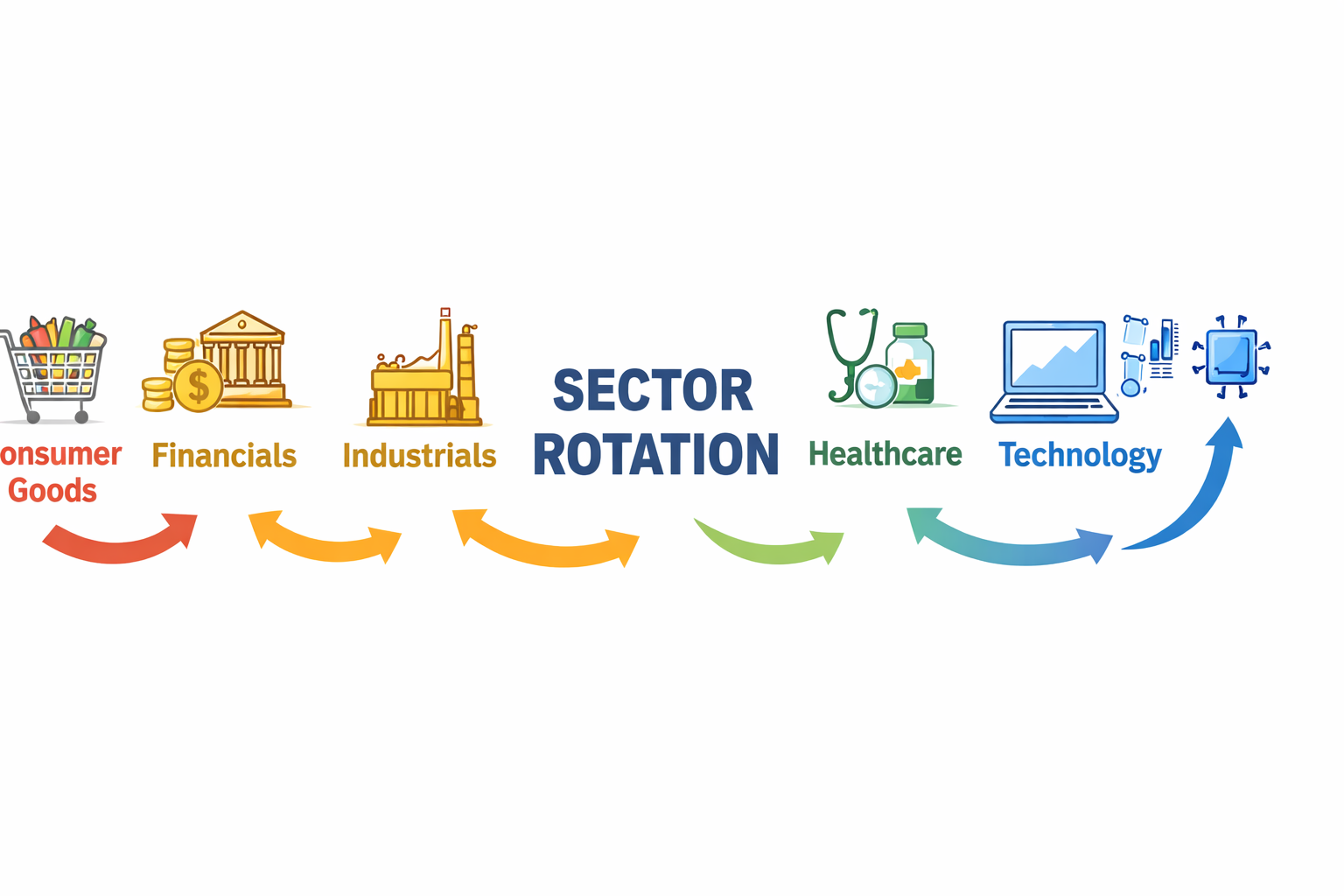
Different sectors outperform at different points in the economic cycle. This is one of the most robust empirical patterns in markets.
The four phases
- Early Recovery (GDP accelerating, rates low)
- Winners: Consumer Discretionary, Financials, Real Estate, Small Caps
- Mid-Cycle Expansion (GDP growing, rates rising)
- Winners: Technology, Industrials, Materials
- Late Cycle (GDP peaking, inflation rising)
- Winners: Energy, Materials, Healthcare
- Recession (GDP contracting, rates falling)
- Winners: Utilities, Consumer Staples, Healthcare, Gold
Macro regime weight adjustment
Our scoring engine adjusts pillar weights based on regime. In rate-tightening: Quality gets +4, Momentum gets -2.5. In expansion: Growth gets +2, Quality gets -2.5. This isn't market timing — it's systematic recognition that different factors work in different environments.
The COT positioning signal
The home page shows Commitment of Traders data. When commercial hedgers build net long positions in gold and net short in equities, that's historically been a reliable recession warning — usually 6–12 months in advance.
Don't over-rotate
Sector rotation works as a tilt, not all-or-nothing. The cycle is identified in hindsight — by the time you're sure we're in recession, the recovery trade has started. Stay diversified, lean into the cycle.